
A veteran ski journalist explains Lindsey Vonn’s return to downhill racing: why she retired, how her body changed, and what’s at stake when hurtling down a slope on an artificial knee.
Published: Jan 31, 2025 on Outside Online …
A veteran ski journalist explains Lindsey Vonn’s return to downhill racing: why she retired, how her body changed, and what’s at stake when hurtling down a slope on an artificial knee.
Published: Jan 31, 2025 on Outside Online …
Filed under Uncategorized

Spin to start.
Occupation:
Land on Broadcast Journalist. Stay in 5-star hotel, given driver. Collect $5,000 at each Pay Day. Advance to Hair & Makeup. Then skip from Pay Day to Pay Day.
Land on Print Journalist. Stay in 2-star dump, given metro card. Collect $100 at each Pay Day. Advance to Main Press Center.
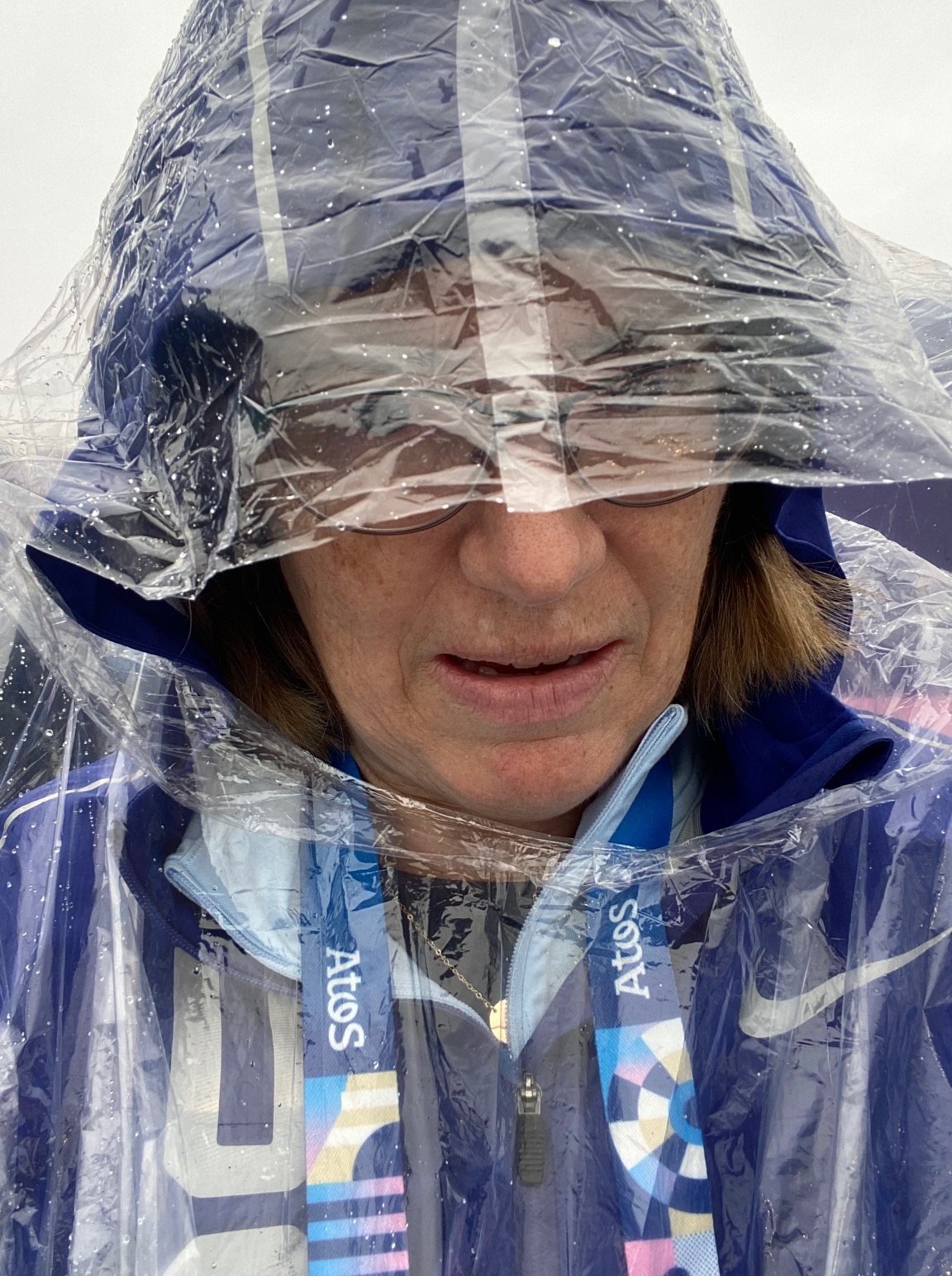
Spots on the Board:
Accreditation mix-up. Return to Main Press Center.
Board train going in wrong direction. Lose a turn.
Catch an infectious disease. Lose two turns.
Find athlete’s parents in the crowd. Collect another $200.
Score assignment at outdoor venue on nice day. Collect 100 mental health points.

Score assignment at outdoor venue on hot day. Pay $20 for water and Gatorade.
Miss athlete in mixed zone. Skip over the next Pay Day.
Cover 3 events in one day. Lose 100 mental health points.
Cellphone battery low. Lose a turn.
Score 1-on-1 interview with athlete in Village. Advance to next Pay Day.
Ask volunteers directions to media venue. Go back two spaces.
Have sit-down lunch with fellow journalists. Eat vegetables. Pay $50 and gain 100 mental health points.
Share mixed zone audio with another journalist. Make a friend. Earn 100 mental health points.
Receive day’s assignment after 9 a.m. Lose 500 mental health points.
Cover sport about which you know nothing. Lose 100 mental health points but go straight to next Pay Day.
Final Pay Day.
Go to airport. Flight delayed! Lose remaining mental health points.

Go to airport. Score upgrade! Gain 100 mental health points.
Day of Reckoning: Cash in mental health points. If greater than zero, go to the next Olympics.
Filed under Uncategorized
U.S.’s Youngest Olympian Wins Gold
Katie Ledecky wins gold in her first international swim meet.
By Peggy Shinn (from TeamUSA.org, August 3, 2012)
LONDON — Two months ago, Katie Ledecky finished her freshman year in high school.
Tonight, in her first final in international competition, the 15-year-old freestyler recorded the second fastest 800-meter freestyle time in history and beat the American record held by Janet Evans since 1989.
Better still, Ledecky swam away with an Olympic gold medal.
And she had Missy Franklin, Elizabeth Beisel, and Michael Phelps to thank. In the two races before the 800m final, Franklin set a world record and Beisel won a bronze medal in the 200 backstroke, while Phelps won gold in the 100m butterfly.
“Missy and Michael’s races really got me pumped up,” said a wide-eyed Ledecky, still dripping from the pool. “I just wanted to see how well I could do to represent the U.S.”
It’s been a whirlwind year for the teen from Bethesda, Maryland. Last August, she competed in Junior Nationals — not senior nationals, like most 2012 Olympic hopefuls — and won the 400, 800, and mile. When she sat down with coach Yuri Suguiyama in the fall, they talked about the 2012 U.S. Olympic Trials.
“Katie, what would be the ultimate goal there?” he asked.
She gave the typical teen response: “Um, what? I don’t know.”
He asked her again, and she replied hesitantly, “Make the Olympics?”
Yes, replied Suguiyama, and he promised not to tell anyone.
Balancing training and ninth grade at the Stone Ridge School of the Sacred Heart in Bethesda, Ledecky worked hard. In February, she won the 800 at the Missouri Grand Prix in 8:30.14. But the field was not deep.
Then at U.S. Olympic Trials in June, she dropped over 10 seconds off her time and won the 800, beating former world record holder Kate Ziegler — one of her idols.
At training camp before the Games, she gained confidence and speed, and it did not go unnoticed by her teammates.
“We kind of watched her come out of her shell during camp,” said Phelps. “She was always just having fun. You could tell she felt very comfortable.”
Arriving in London, Ledecky was far off the radar. She was, after all, the youngest member of the entire 529-member U.S. Olympic team.
Instead, all eyes were on reigning 800 world champion, defending Olympic gold medalist, and British darling, Rebecca Adlington, as well as Dane Lotte Friis, the 2011 world runner-up. The British swimmer set the 800 world record of 8:14.10 at the 2008 Olympics.
But Ledecky was only thinking about the world records and gold medals earned by her teammates.
In the ready room, Phelps gave her a high-five and told her to have fun out there, a gesture that made Ledecky think back to the first time she met him at 2003 U.S. nationals. She was six at the time and had not started swimming yet. But the future 21-time Olympic medalist stopped to sign his autograph, then he waved as Ledecky and her family drove off. The memory calmed her down as she waited for the 800.
Then, right before she walked onto the pool deck, she watched both Franklin and Phelps take gold medals, and Beisel earn bronze.
“I was ready to scream when I saw Missy and then Michael’s race,” said Ledecky, who watched their races from the ready room. “But I kept it to myself and just used it as extra energy.”
Ledecky seemed turbo-charged from the start, diving into the pool and going “hard from the get-go,” said Adlington.
“I tried to go out a little more controlled,” Ledecky said. “But I just got so excited when I was racing, and I felt really good.”
As the media interviewed Phelps after his final individual Olympic race, Ledecky was on a TV monitor on the other side of the room. Only 150 meters into the race, she was over a body length ahead of her nearest competitor — and well ahead of world record pace. Reporters had their microphones turned toward Phelps and their eyes on the TV.
Ledecky stayed above world record pace until the final 50.
“I figured I was going pretty fast,” she said. “At one point I thought, well, if I’m going to be close to this world record, I don’t even care. I want to get my hand on the wall first.”
She touched the wall in 8:14.63 — only 53/100ths over the world record.
“I didn’t really expect gold,” she added. “But I’ll take it.”
After climbing out of the pool, Ledecky thanked Franklin and Beisel for the inspiration they provided by swimming so well themselves.
“I’m really happy that I could do something to get her spark going,” said Beisel.
Ledecky’s gold was a good sign for American distance swimming. U.S. women once dominated the event at the Olympics, most notably Janet Evans and Brooke Bennett, who won back-to-back Olympic gold medals in 1988-1992 and 1996-2000, respectively. But no American woman has won gold in the event since Bennett a dozen years ago.
Phelps was all smiles talking about Ledecky’s swim tonight and her bright future.
“She went out there and laid it all on the line,” he said. “It looked like she went out and had some fun, won a gold medal, and just missed a world record. I’d say that’s a pretty good Olympics for a 15-year-old.”
##
Peggy Shinn is a freelance contributor for TeamUSA.org. This story was not subject to the approval of the United States Olympic Committee or any National Governing Bodies.
Filed under Uncategorized
After the spate of severe injuries to several alpine World Cups stars in winter 2023-2024, Lindsey Vonn made some suggestions about how to make the Alpine World Cup safer.
Filed under Uncategorized
Here’s a story I wrote for TeamUSA.com in 2020 about Sepp Kuss–after talking to his mom Sabina, who’s wonderful, and his first cycling coach.
Meet Sepp Kuss, the American Cyclist Helping This Year’s Tour de France Leader
By Peggy Shinn
They said today’s race, with two massive Alpine climbs, was the hardest stage of the 2020 Tour de France.
And there, with 2 kilometers to go, was an American cyclist at the front of the race, dancing on his pedals up La Col de la Loz’s steep grades, setting tempo for his Jumbo-Visma team leader, Slovenian cyclist Primož Roglič, the man in the Tour’s yellow jersey.
His name is Sepp Kuss. And after he launched a key attack on a high alpine road above the French town of Méribel today, he helped Roglič get a gap on his nearest rival—Tadej Pogacar, also from Slovenia, who sits in second place overall. Kuss even led the race for a few minutes, but then dropped back to help his team leader.
“I was just trying to set a good pace,” said Kuss, who is racing his first Tour de France. “And then I look back and there was a gap, and [stage winner Miguel] Lopez came across . I couldn’t stay with Lopez, so I backed off and tried to pace Primoz.”
Roglič finished second behind Lopez, but crucially, 15 seconds ahead of Pogacar, and Kuss crossed the line in fourth.
With four stages left in this year’s Tour, Roglič sits in first, 57 seconds ahead of Pogacar.
Kuss has been the consummate teammate for Roglič—his chief lieutenant in key mountain stages. In fact, Kuss might be the best American climber since Andy Hampsten, who in the 1980s helped Greg LeMond win the Tour de France and then won a Grand Tour himself (the 1988 Giro d’Italia).
So who is this young American who has helped Roglič maintain the Tour leader’s yellow jersey and might one day wear the yellow jersey himself?
Life in the Mountains
Sepp Kuss is a product of the mountains. He was born in Durango, Colorado, and his parents, Dolph and Sabina Kuss, were cross-country skiing with their baby when he was just a couple months old.
Sabina is a long-time cross-country ski instructor at Durango Nordic and a world masters competitor, and Dolph competed for the national Nordic ski team in the 1950s, then coached the U.S. Ski Team from 1963-1972 and at two Olympic Winter Games (1964 and 1972). He was also the first men’s ski coach at Fort Lewis College in Durango and helped develop several NCAA champions.
The Kuss side of the family also has high-mountain blood. Sepp’s great-grandparents immigrated to Leadville, Colorado (elevation 10,151 feet) from Slovenia and Italy in the 1800s for the mining opportunities, and Dolph grew up there. He moved to Durango in the 1950s.
Durango is nestled at the foot of the San Juan Mountains, and it was in these mountains where the Kusses spent every summer on raft trips and taking week-long pack trips with their three burros. Baby Sepp rode atop Hilda, a burro with maternal instincts. If he dropped his baby bottle or his stuffed cat, or if his little seat slipped, Hilda would stop.
“I don’t know if I’m getting too far-fetched, but being in the mountains, in that scenery and the slow steady rhythm of hiking with burros, in all seriousness, I think that had something to do with the incredible calmness that Sepp has,” said Sabina.
When Kuss was old enough to hike alongside the burros, he carried his own pack.
“He never complained, and he never asked for anything,” said Sabina, who still marvels at her son’s demeanor.
And he liked doing everything—from whitewater kayaking, which he started in first grade, to cross-country skiing to mountain biking to ice hockey. When cross-country ski races would conflict with hockey, Kuss invariably picked hockey. He didn’t want to let down his teammates.
“He always did what was purely in his heart,” said Sabina. “He never cared what his peers did.”
Nor was he competitive. Until the fifth grade.
That’s the year he announced that he wanted to be a pro hockey player. He was quick and agile on his skates. But a career as a pro athlete seemed far-fetched.
Their son seemed too considerate, too kind for cut-throat sports. When the family traveled, Sabina would ask her son what he wanted to do.
“He would look at me and Dolph and say, ‘What would you and Papa like to do?’” explained Sabina. “He always put someone else first.”
And he had other interests—he learned German, liked to build bikes, and sang and played guitar. His repertoire included mostly Elvis Presley songs, “All Shook Up” being a favorite.
When he was 9, he did a solo stage performance for a friend’s wedding.
While his hockey dreams soon faded—Kuss was too small for a sport that involved checking (5’11” and 134 pounds, according to his Wikipedia profile)—his cross-country skiing prospects looked good. From eighth grade through his junior year in high school, Kuss qualified for junior nationals.
But by senior year, Kuss was squarely focused on mountain biking and Durango High School’s team. It was a sport he had pursued for years, but just for fun. In fact, the Kusses had given up their much-loved pack trips because their son wanted to spend the summer mountain biking.
At first, he mountain biked with his mom, who also has a big aerobic engine. She often races the famed Iron Horse Classic—an annual 50-mile bike race from Durango to Silverton over two 10,000+-foot mountain passes—and has won her age group many times over.
“He always wanted to go with me,” she said, “and he would always wait at every junction.”
Even so, Sabina felt as if she were slowing her son down. So she sent him to ride with Chad Cheeney, co-founder of Durango’s DEVO program. He was leading a few other youngsters on Monday rides.
“Chad was perfect because he wasn’t ever about creating racers,” said Sabina. “It was getting together and just having a great time.”
Asked if he saw talent in young Kuss, Cheeney assumed he would grow up to be good at some sport, given his parents’ athletic pedigrees.
Still, Kuss did not look like he was on a path to become Durango’s next cycling legend. In junior races, Kuss usually finished behind his friends. But his parents didn’t care.
“The constructive post-race talk from his dad, his parents were so supportive,” said Cheeney. “Any result he got, they were super supportive.”
From Mountain Biking to Road Racing
Kuss graduated from Durango High School in 2013 and went to the University of Colorado in Boulder. There, he began showing his talents on two wheels. Around Boulder, he began capturing hill climbing KOMs (King of the mountains) on Strava. He also won three national mountain biking championships for CU-Boulder, and one collegiate road racing title.
“You knew he could do it if a team gave him a chance,” said Cheeney.
Kuss considered the pro mountain biking landscape. Domestic trade teams are few and far between, and the sport, for the most part, has become a points chase—a trek around the world in the hunt for UCI points so riders can earn better world cup start spots. Only the top-ranked riders, who start at the front of every world cup, have a shot at winning, he realized. His passion for mountain bike racing began to wane.
Around the same time, a Durango friend invited Kuss to join an amateur road racing team. He finished respectably in well-known stage races, The Tour of the Gila in New Mexico and the Cascade Classic in Oregon, that spring and summer.
The following season—2016—Sepp finished fourth in The Tour of the Gila’s first stage, the 3.8-mile Mogollon climb with steep gradients of 15 to 19 percent. Then he won a stage of the Redlands Classic in California, beating a couple of former WorldTour riders.
From there, Sepp’s ascent up cycling’s food chain was quick.
He was picked up by a domestic pro team and two days after he graduated from CU-Boulder with a degree in advertising, he competed in the Amgen Tour of California.
Kuss’s results—including a sixth place finish overall in the 2017 Colorado Classic—caught the attention of the Dutch team Jumbo-Visma. And he quickly proved his worth to his new team. Kuss dominated the 2018 Tour of Utah. A month later, he raced in his first Grand Tour, La Vuelta a Espana (Tour of Spain).
A couple of top twenty finishes in Spain earned him a spot at the Giro d’Italia (Tour of Italy) for spring 2019, where he helped Roglič—a former ski jumper—finish third.
The opportunities kept mounting. In last year’s Vuelta, Kuss won a stage—his first Grand Tour victory—and helped Roglič win the overall title.
“He really likes the strategy of road racing,” explained Sabina, who had planned to go to France this summer to watch the Tour but was forced to cancel because of the Covid-19 pandemic. “He likes that there’s all types of scenarios where someone could win. It takes tactics, strategy, and teamwork.”
“He’s just so well-rounded,” explained Cheeney. “I think that’s why he’s gotten where he is. He wasn’t all-in on his engine at an early age.”
2020 Tour de France
After the Covid-19 lockdown last spring, which Kuss spent in Spain with his girlfriend Noemi Ferré, he won a mountain finish in the five-day Critérium du Dauphiné last month.
“I think everybody came out of the coronavirus break really motivated and fresh,” Kuss told the Durango Herald on the eve of the 2020 Tour de France. “Every day [of the Dauphiné] was full-on, and to come out of that and win on the last stage gave me a lot of confidence.”
Early on in the 21-stage Tour de France, Kuss showed how hard he would work for his team. In stage 4, he led out Roglič for the win. And every day since then, he has been part of the Jumbo-Visma train at the front of the peloton.
“Every day, I’ve been feeling better, much better than I felt in the first week, so that’s a nice feeling to have this far into the race,” Kuss said on Sunday—his 26th birthday.
This week, Kuss is in his element—the high mountain stages of the Alps. Yesterday, he helped Roglič finish second, and then he crossed the line in sixth place.
Then came today’s stage, with its finish atop La Col de la Loz, featuring torturous 24 percent grades. In the final 4 kilometers of the climb, all the top ranked men in the Tour standings were together. But Roglič was the only contender who had a teammate in the group—Kuss.
Kuss’s attack in the final 2 kilometers helped drop Pogacar off Roglič’s wheel. By the finish, Roglič finished 15 seconds ahead of Pogacar and earned a time bonus. Kuss ended up dropping off Pogacar but still finished fourth in the stage.
“The fact is every meter on this climb that you can have some help is really valuable,” said Roglič. “So for me it was really welcome that Sepp could do some meters for me. It was just a brutal climb.”
Kuss moved up to 15th place overall. But road cycling is a team sport, and his finish is secondary to Roglič’s overall Tour win. It’s never ‘I’ for Kuss, it’s ‘we.’ The Tour has four more days until it concludes in Paris on Sunday.
“Tomorrow is also a really tough stage,” said Kuss. “So we have to do our best and recover and be ready for another really hard day tomorrow.”
An award-winning freelance writer based in Vermont, Peggy Shinn has covered seven Olympic Games. She has contributed to TeamUSA.org since its inception in 2008.
Filed under Uncategorized
Sibling dynamics can do much to shape who we are. So I looked at the stats of all U.S. Olympic medal winners from the 2016 and 2018 Olympic Games. What do multiple gold medalists have in common? At least one older sibling–and for women, an older brother.
Filed under Uncategorized
Always an honor to write about Olympic and sports history.

Filed under Uncategorized
Yesterday, as we in the “print” media waited to talk to Mikaela Shiffrin after she had skied out of the 2022 Olympic slalom at the fifth gate, a British journalist asked, tongue-in-cheek: “What would we say if we were interviewed in front of the world after every mistake we’ve made?”
“Oh right,” we responded collectively, nodding (and cringing).
“So, how does it feel to have made that error so early in the text?” he joked, mimicking a TV broadcaster. “How do you come back from such an egregious error?”
The 20-or-so of us in the media scrum howled with laughter (probably violating COVID protocols). The best humor is based in truth, and none of us was looking forward to the task at hand — interviewing a disappointed athlete who was “expected” to win. It’s never easy. As humans, we do not like asking questions that cause pain. But at times like this, it’s our job.
When she reached us, Shiffrin took some time to gather herself. It was her second DNF — she had only made it five gates in both the giant slalom and slalom. And for the second time in two days, she was facing the media without her usual smile.
I for one did not know what to say. As a human and a parent, I just wanted to hug her and say I was sorry.
After a long pause, one of the journalists asked softly: “Mikaela, what happened?”
Another long pause. Then she responded but haltingly. She has always strived to give honest, introspective answers, to explain her feelings and her skiing. But this time, she was struggling to find the right words.
“Um …
“I have … I was … pushing and … maybe it was just past my limit … But I was … I was … I had the intention to … do my best skiing and my quickest turns. But in order to do that I had to … push the line, the tactics and … It’s really on the limit then, and things happen so fast that there, there was not space to slip up even a little bit … and I don’t know … I was … I started with a strong mentality and then I was out of the course. … And that was …
“It’s disappointing.”
DNFs are not something Shiffrin is used to. Until the 2022 Olympic Winter Games started this week, she had competed in 228 World Cup, world championship, and Olympic races and only DNFed 16 times. In other words, in a sport as brutal as ski racing — where the slightest mistake can cost a skier to fall far down the results sheet, ski out, or worse, get injured — Shiffrin has finished 93 percent of her races. By comparison, Lindsey Vonn only finished 80 percent of hers.
Shiffrin trains hard for ski racing. It’s her career — her job — and she always goes for the extra credit. The combination of natural talent and hard work has helped her turn balance into her super-power. She seems to iron out bumps and ruts, with very little throwing her off. While others slam hard on their edges and/or flail a bit as they get thrown into the backseat, Shiffrin dances down the hill, barely touching her edges, always on top of her skis.
Tap, tap, tap. It’s as if gravity has a different effect on her.
She makes it look easy. And for this reason, we think of her as a sure bet — the one who will bring home the gold while others are long shots.
Even better, she is gracious in victory, thanking the media, the fans, her team, everyone who has helped her. She is humble, too, and at times, humorously self-deprecating — a true role model and inspirational champion.
Now suddenly, at the Olympics, she was in unfamiliar waters. Two DNFs on the world’s biggest stage. She was not sure how to handle it. She could have blown by reporters. Or stopped and only curtly answered two questions. We have certainly seen that happen before.
Instead, she spent 20 minutes with us — after talking to broadcasters and the wire services for even longer. And she opened her heart.
She felt like she had let everyone down, she said — her team that had worked so hard to get her to three Olympic Games, five world championships, and 210 World Cups, her fans who hold “We Love You” signs at races, her teammates, everyone.
“It really feels like a lot of work for nothing,” she said.
Her goal from the start was to ski aggressively. To really go for it. Already a legend, she still wanted to put on a show. Maybe the pressure got to her, she suggested, but she did not really know. She has learned to carry the weight. But who really knows?
“It’s probably better to ask a psychologist about that,” she said, then added wryly, “or everybody’s going to have an opinion anyway, so …”
“Honestly, I’m at a loss,” she continued. “It’s hard to really know what exactly went wrong aside from I slipped up a bit on one turn and didn’t have enough space to recover from it.”
For Shiffrin, it’s always been about the skiing — trying to make perfect turns, trusting in the process, trusting in her skiing. We have become accustomed to seeing her finish in spectacular fashion, winning by big margins. Now, at her third Olympics, with two DNFs on her record, she thought she had failed.
Far from it.
Her honesty in defeat is more inspiring than her skiing. She answered every question through tears and an occasional laugh, bearing her soul.
She wished that she had had more time on the course — to regain her balance and get back into it. But she also recognized that there were 84 other women — the 84 who finished behind winner Petra Vlhova — who also wanted more time.
“So if the worst thing that happens is this, I mean, I didn’t finish in the Olympics, come on,” she said. “That hurts, but in 24 hours, nobody’s going to care.”
Shiffrin has already experienced the worst thing that can happen. Her father died in an accident two years ago. It is a tragedy that broke her heart. It is, she has said, the worst injury she will ever have. Even in death, he has continued to provide perspective — that a DNF or losing a race is not the end of the world.
Now, at these Olympics, Shiffrin really wanted to call her dad.
“He would probably tell me to just get over it,” she said with a wry laugh. “But he’s not here to say that so …
Long pause.
“On top of everything else … I’m pretty angry at him too.”
Another long pause, as we quietly choked up.
“That sounds like a lot,” a reporter finally said, probably a mom herself.
“What could you do as a person, as a human, forget being a ski racer, to feel better in the coming days?” the reporter then asked. “You can’t go anywhere here, you can’t do anything, and you have a swab shoved down your throat every 15 minutes [to test for covid].”
Which gave Shiffrin the laugh she needed. The laugh we all needed.
Shiffrin paused, looked around, and then responded: “Despite everything that I’m feeling, I mean, if you kind of look around, it’s a pretty beautiful day.”
“And I have incredible teammates here. One of them got a silver medal yesterday,” she continued, referring to Ryan Cochran-Siegle’s medal in men’s super-G.
“My boyfriend is here. He got a bronze in super-G. He’s been working so hard to get an Olympic medal his whole career, and he’s had some really bad luck. And I have three medals. Those are still back home in my closet.”
She laughed again.
“As disappointed as I feel and as much as I’m feeling right now, there’s so much to be optimistic about. it feels like there’s a lot to be disappointed about right now, too.
“But you know what, the throat swab tests, they make you choke a little bit, but they’re not that bad. And the people here have been so friendly, it’s so welcoming and kind.
“And it’s COVID, it’s a pandemic, but here we are at the Olympics.”
Yes, here we are at the Olympics, interviewing a real champion, who has let us glimpse her soul. She has pulled back the curtain, letting us bear witness to the fact that she struggles with the same thoughts, insecurities, and emotions that the rest of us do.
Perhaps showing us her human side is Shiffrin’s real super-power. She is as inspiring in defeat as she is in victory.

Filed under Uncategorized

I hope kids remember what Simone Biles did — and for more than the mental health benefits.
By pulling out of the women’s gymnastics team final the other night, Biles stood up for herself and her mental health. She’s another high-profile athlete who is talking openly about mental health, removing the stigma, and I applaud it. Mental health has been buried in the closet for far too long.
But my first reaction to Biles’s withdrawal had more to do with her physical wellbeing. She was not in the right headspace to perform well. And foundering confidence can lead to injury.
It reminded me of our friends’ daughter, a ski racer who tore her ACL several years ago in a race where conditions were questionable. The giant slalom course was deteriorating, and racers before her had fallen and injured themselves. It was not a situation that instills confidence.
But with pressure to score FIS points, pressure not to waste money (race fees! travel expenses!), pressure from coaches (perceived or not), pressure from family and peers (again, perceived or not), she pushed out of the starting gate. Then part way down the course, in poor visibility and rotting snow conditions, she crashed. It was her second ACL tear.
Had she said, “Nope, not doing it, not today,” she would have saved herself months of rehab and the mental anguish of being sidelined from a sport she loves. But as a kid, it’s difficult to make this call. They risk disappointing the people they so badly want to please.
But if kids can remember that Biles had the courage to say, “Nope, not doing it, not today” on the world’s biggest sports stage — with the weight of the world on her shoulders, and while carrying the expectations of her teammates and coaches — then maybe kids too can save themselves from potential injury. Not all the time, but sometimes.
Granted, there is a fine line between pre-competition nerves and crippling anxiety. And kids — heck, even most adults — can have a difficult time distinguishing between the two. Perhaps coaches and parents could come up with some questions to ask young athletes if they notice them looking out of sorts on competition days.
Or maybe kids could ask themselves, “What would Simone do?”
Filed under Uncategorized
 Peggy Shinn